
kuz.

episode · biology

Are you a thing, or a pattern?

Your skin is weeks old, your skeleton about a decade. You are the shape the matter keeps flowing through.

Thumbnail for Are you a thing, or a pattern?

The short answer

You are not a fixed object. Your epidermis turns over in roughly two to four weeks. Most of your red blood cells live about 120 days, so your blood is renewed over a few months. Your adult skeleton remodels almost completely across about ten years. And the much-repeated popular-science figure, traced to Paul Aebersold's radioisotope work at Oak Ridge, holds that around 98 percent of your atoms are swapped out every year. The matter keeps changing, yet you persist. What stays is not the stuff but the pattern, the way a flame remains while the gas burns away, or a wave keeps rolling while the water moves on. You were never a thing. You were always a pattern the atoms pass through.

Transcript

Look at your hand. The skin you're looking at didn't exist a month ago.

Your blood is renewed every few months. Your skeleton rebuilds itself over about a decade.

And your atoms - around ninety-eight percent of them - are swapped out every single year.

So if the stuff keeps changing... what actually stays?

You are not made of matter. You are made of pattern.

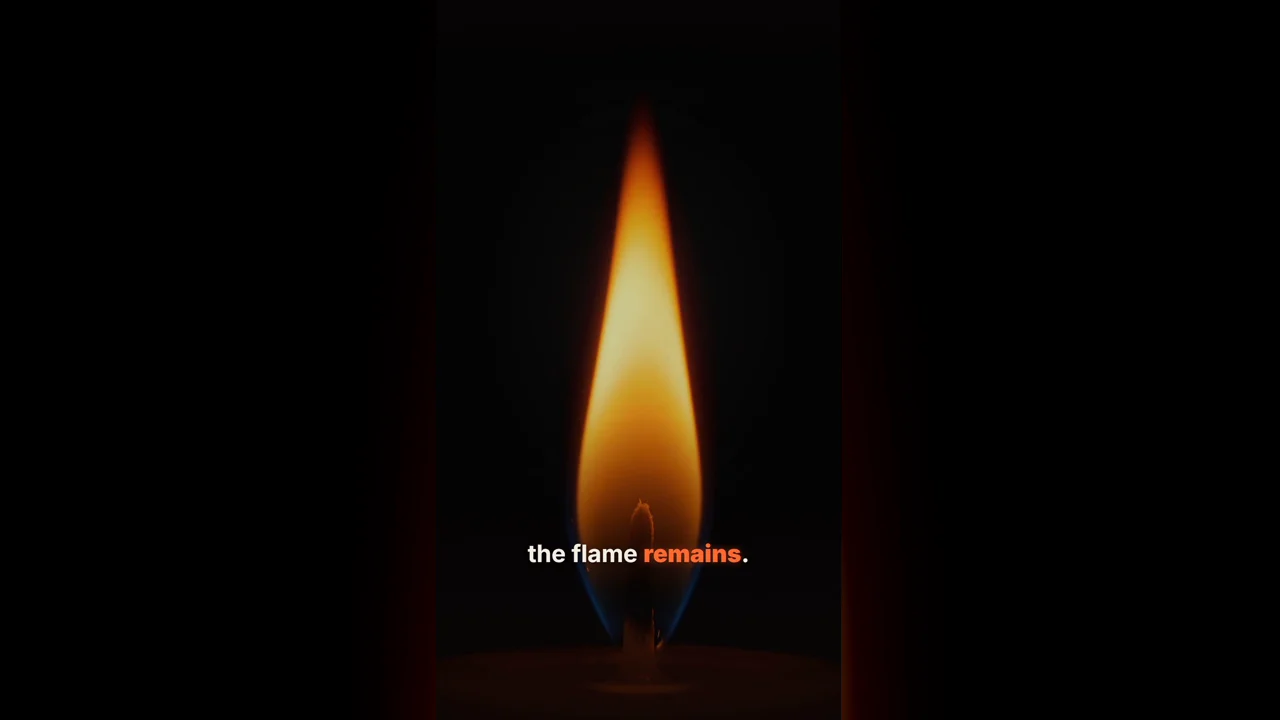
Like a flame - the gas burns away, but the flame remains. Or a wave - the water moves on, but the wave keeps rolling forward.

The atoms just pass through you. You are the shape they keep making.

The you from seven years ago is, physically, almost gone.

And one day, the shape lets go - and your atoms drift on... to become rain, and soil, and someone else.

You were never a thing. You were always a pattern.

Sources

  1. Iizuka, H. (1994). "Epidermal turnover time." Journal of Dermatological Science, 8(3), 215-217. Measurements of keratinocyte transit from the basal layer to the skin surface place full epidermal turnover on the order of weeks rather than days, the basis for the statement that the outer skin you see is only weeks old. Open source
  2. Barbalato, L., Pillarisetty, L. S. (2023). "Histology, Red Blood Cell." StatPearls, NCBI Bookshelf. States that each red blood cell lives for about 120 days, roughly four months, which is why the circulating blood supply is continuously renewed over a period of months. Open source
  3. Office of the Surgeon General (US). (2004). "The Basics of Bone in Health and Disease." In Bone Health and Osteoporosis: A Report of the Surgeon General. NCBI Bookshelf. Describes continuous bone remodeling by basic multicellular units, with roughly 10 percent of cortical bone replaced per year, so the adult skeleton renews almost completely over about a decade. Open source
  4. TIME, "Science: The Fleeting Flesh" (October 1953). The widely cited claim that about 98 percent of the atoms in the human body are renewed each year traces to radioisotope tracer studies by Dr. Paul C. Aebersold of Oak Ridge, reported in the Annual Report of the Smithsonian Institution. It is a popular-science figure, not a precise constant, and turnover varies by tissue and element. Open source
  5. Feynman, R. P. (1955). "The Value of Science." Engineering and Science, 19(3), 13-15 (Caltech). The framing that a living thing persists as a pattern the atoms pass through, rather than as a fixed set of matter, is Feynman's: "The atoms come into my brain, dance a dance, then go out; there are always new atoms, but always doing the same dance." When you learn how long it takes the atoms of the brain to be replaced, he writes, you see that what you call your individuality is "only a pattern or dance." Like a flame or a standing wave, you are a process, not a substance. Open source

related

other things you've googled.

follow kuz for the next answer.

Follow kuz on YouTube